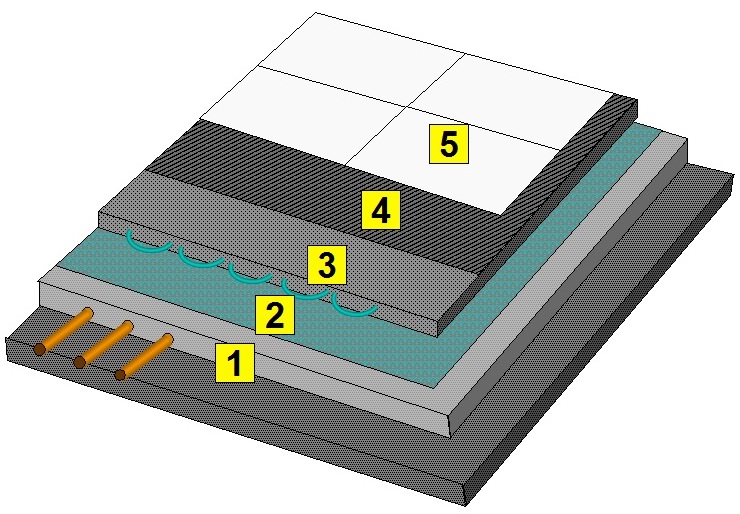
Cement screed over radiant floor heating and an impact sound insulation mat.
Structure type
Cement screed with radiant floor heating laid over a lightweight insulating fill, with an interposed PE mat against impact sound transmission.
Detail
Tile installation on a heated screed with normal working time and rapid drying and hardening.
Application cycle
- Aerated concrete, or a mix of cement and polystyrene or other lightweight aggregate, at least 5 cm thick, laid on the floor structure as a lightweight insulating screed that can also house the building services and provides an even surface for laying the PE mat.
- 10 mm dual-density closed-cell PE mat.
- Installation of the radiant floor heating system, followed by a screed of RALLK Massetto K RA (normal working time, fast drying and hardening), 4 cm thick or more, which settles perfectly around the heating pipes and helps transfer heat to the floor layers above.
- RALLK Kerasiv K Flex adhesive for laying ceramic tiles (single-fired, double-fired, stoneware, clinker or similar), terracotta or natural stone, in large or small formats.
- Ceramic tiles (single-fired, double-fired, stoneware, clinker or similar), terracotta or natural stone, in large or small formats.
Additional information
- The lightweight screed has a dual role: it limits heat loss downwards and creates the "mass - spring - mass" system that reduces impact sound.
- The ΔLw (impact sound reduction) of the system described above can reach 25 dB.
- A flexible adhesive (class S1) is the best choice to reduce the risk of stresses from the radiant heating system being passed on to the ceramic or stone covering.
- See the individual product data sheets for application methods and precautions.
- The radiant heating system should be started 28 days after laying the screed. Switching it on earlier can impair the screed's soundness and reduce its final mechanical strength.
- Commissioning of radiant heating systems is governed by EN 1264-4 and/or the instructions of the heating system manufacturers, and following these procedures is the installer's responsibility. During the first heating and cooling cycle, keep the rooms ventilated to avoid a possible build-up of humidity. Common practice is to start with a flow temperature equal to the surface temperature of the screed (and in any case not below 15 °C), then raise it gradually by 3 °C a day to avoid excessive temperature swings in the screed. Once the maximum operating temperature is reached, it is held for 3 days, after which the screed is cooled in the same way it was heated. The above comes from site experience and not from procedures developed by us. For the steps to follow during testing, start-up and shutdown of the system, refer to the relevant standards or the heating system manufacturers' instructions.
- Ceramic tiles or finishes that are not sensitive to moisture can be laid when the residual moisture of the screed is below 3 %. Wood, linoleum, rubber or other moisture-sensitive finishes can be laid when it is below 2 %.