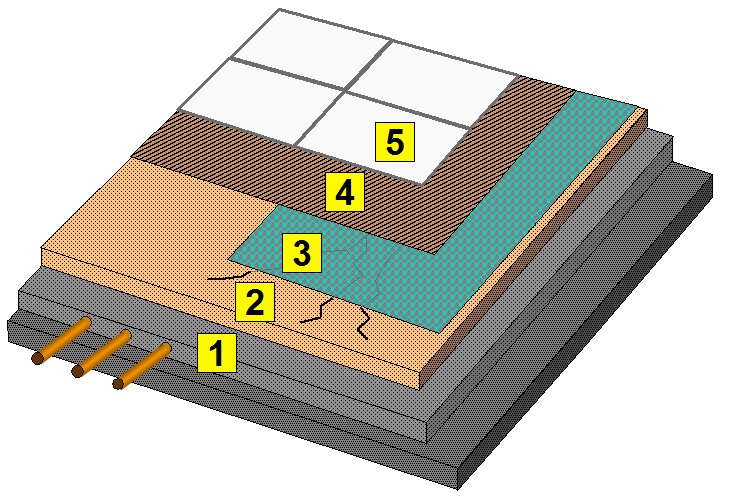
Repair of cracked historic screed.
Structure type
Existing lime screed with non-through hairline cracks, even widespread ones.
Detail
Installation of tiles, terracotta or stone flooring on an existing lime screed with non-through hairline cracks.
Application cycle
- Any existing layer acting as a lightweight insulating screed, with or without building services.
- Lime screed more than 4 cm thick, bonded or floating, with hairline cracks, even widespread ones, caused by shrinkage, thermal expansion or variations in thickness.
- Primed or alkali-resistant glass fiber strengthening mesh of 150–160 g/m2, laid on a first coat of RALLK Kerasiv Kalce adhesive spread with a notched trowel.
- RALLK Kerasiv Kalce adhesive covering and fully embedding the mesh, spread with a steel trowel to give a solid, uniform and even base for laying the ceramic, terracotta or stone tiles.
- Ceramic, terracotta or stone finish covering laid with RALLK Kerasiv Kalce adhesive, indoors or outdoors, in small or large formats.
Additional information
- If the old covering is removed, make sure the substrate is even, sound and clean before starting any work.
- Check that the cracks do not run right through the screed, breaking its continuity. If they do, they must be bonded with a suitable adhesive.
- Check that the cracks are stable and no longer developing, and/or that they are not caused by stresses or loads still acting on the screed and making it move cyclically.
- See the individual product data sheets for application methods and precautions.