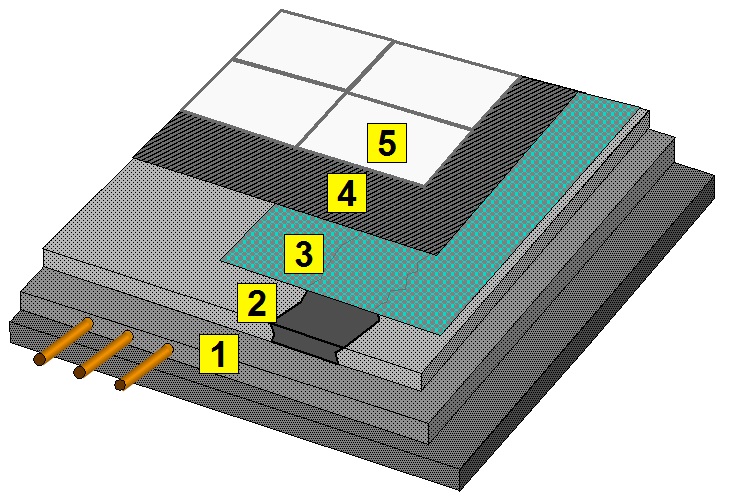
Repair of cracked screed.
Structure type
Existing sand-cement screed with a localized repair in new screed.
Detail
Tile installation on an existing screed after a localized repair.
Application cycle
- Any existing layer of aerated concrete, or a mix of cement and polystyrene or other lightweight aggregate, laid on the floor structure as a lightweight insulating screed that can also house the building services.
- Local repair of the sand-cement screed with fast-drying RALLK Massetto K RA for thicknesses above 4 cm, or with RALLK Massetto K BS for screeds 2 to 4 cm thick.
- Primed or alkali-resistant glass fiber strengthening mesh of 150–160 g/m2, laid on a first coat of RALLK Kerasiv K Flex adhesive spread with a notched trowel.
- RALLK Kerasiv K Flex adhesive covering and fully embedding the mesh, spread with a steel trowel to give a solid, uniform and even base for laying the ceramic or stone tiles.
- Ceramic or stone finish covering laid with RALLK Kerasiv K Flex adhesive for indoor or outdoor ceramic or stone tiles in small or large formats.
Additional information
- After locally removing the screed, make sure the substrate is even, sound and clean before starting any work.
- When screeds more than 4 cm thick are repaired with RALLK Massetto K RA, steps 3 and 4 can be skipped and the ceramic or stone tiles laid directly on the repaired screed. That said, using the mesh as shown in the system above always significantly reduces the risk of problems caused by combining different products applied at different times.
- See the individual product data sheets for application methods and precautions.