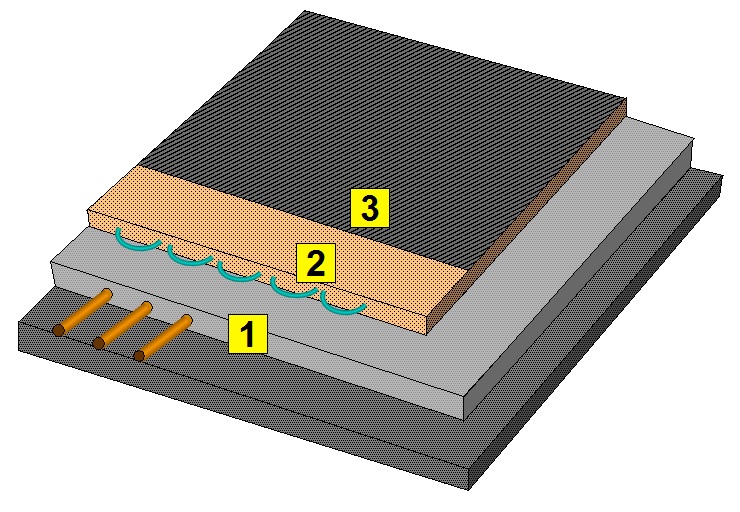
Venetian terrazzo (seminato) finish on lime screed.
Structure type
Natural hydraulic lime NHL 3.5 screed with a “battuto” or “seminato” effect finish.
Detail
Finish coating on a natural hydraulic lime NHL 3.5 screed.
Application cycle
- Supporting subfloor.
- RALLK Massetto Kalce based on NHL 3.5 natural hydraulic lime, 4 cm thick or more, with or without radiant heating.
- RALLK Marmo K Floor ESA nhl finish coating, also available in custom earth tones, based on air lime, NHL 3.5 natural hydraulic lime and celluloses, available in a "grained" version (type 7) with pure selected aggregates with a maximum grain size of 0.4 mm to 1.2 mm or a "non-grained" version (type 13). Limestone or silica chippings, glass fragments or cocciopesto can be added while mixing, or cocciopesto or chippings can be sown into the floor after laying, as long as the mix is still in its plastic phase. The type and amount of aggregate added during laying and the way the surface is finished make it possible to obtain many of the effects typical of "Venetian terrazzo" floors.
Additional information
- Why the existing screed must be checked
The durability of the product and how well it keeps its looks (e.g. no hairline cracks) are closely linked to the nature of the supporting screed. Once cured, the applied product, if bonded to the screed, will follow the movements and deformations of the screed. For a successful result, the screed to be finished with Marmo K Floor ESA nhl must therefore:
- be free of hairline cracks and potential stresses
- be fully cured and not subject to movement
- rest on a stable, unyielding subfloor so that vertical loads are evenly distributed
- be more than 4 cm thick at its thinnest point
- have no pipes or cables running through it (e.g. drainpipes or corrugated conduits)
- be separated from the side walls
- have the expansion joints required by good practice
If these requirements are not met or checked, the finish coating may develop problems such as cracking or loss of flatness. A glass fiber reinforcing mesh in the supporting screed improves its stability.
- Adding chippings or cocciopesto
Chippings or cocciopesto can be added while mixing the product with water, or "sown" onto the floor after laying, as long as the mix is still in its plastic phase.
To spread the chippings or cocciopesto as evenly as possible, adding them while mixing the product with water is preferable.
The type and amount of chippings added depend on the desired look, provided the chippings are:
- clean and free of organic matter
- free of fine and very fine particles (as a guide, nothing passing a 2 mm sieve)
and the amounts follow the guidelines in the table:
|
|
|
Cocciopesto |
Chippings |
|
Marmo K Floor ESA |
Type 7 |
3-4 kg/bag |
5-6 kg/bag |
|
Marmo K Floor ESA |
Type 13 |
8-9 kg/bag |
12-13 kg/bag |
Given the special nature of this work, we recommend a preliminary on-site assessment/trial of the mix to confirm its workability, plastic properties, working times on the substrate, strength once cured, final look and consumption.
Mix in a concrete mixer until the mix is plastic, uniform and lump-free. Avoid long mixing times and stop as soon as the mix is uniform. Use the plastic mix within one hour.
- Grinding the surface
If required, the finish coating can be sanded and/or ground at least 2 weeks after laying, and in any case only after checking that it has reached sufficient strength.
- Further instructions
Wet substrates: do not apply on substrates that are wet, saturated with water or affected by rising damp, and keep rainwater away from the material for the first week after application.
Frost protection: do not apply at temperatures below 5 °C, and protect the applied material from frost for the first 48/72 hours after application. Antifreeze admixtures do not work and may impair the workability, performance and durability of the applied product.
High temperatures/absorbent substrates: in hot or very windy conditions, or on very absorbent substrates, take every precaution to keep the product from drying too quickly and its working time from being cut short.
Dirty or weak substrates: do not apply on substrates that are poorly cohesive, dusty, affected by salt efflorescence, with traces of mold or other organic matter, or soiled with oil or grease. If needed, clean and/or consolidate the substrate with acrylic primers.
See the individual product data sheets for all application methods and precautions.